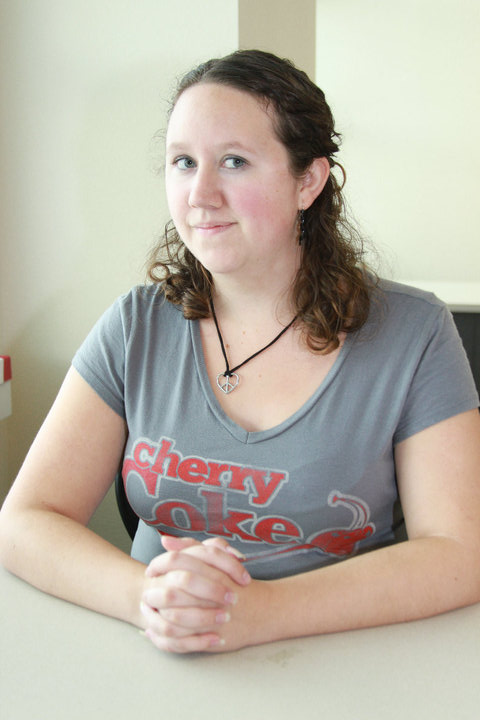


Katelyn is a Staff Writer for the Prairie, who started working in Spring 2010. She is a junior double majoring in Mass Communication - Print and Political Science. You can contact her by e-mail.
Students in Free Enterprise (SIFE) won their 17th Regional championship. Last year the team was first runner up in the first round of Nationals.
“We have great team members who are passionate about SIFE and making a difference in the community, great project leaders and officers who have invested a significant amount of project hours to make things happen,” SIFE vice president Karina Lindary said. ”Our projects are cost-effective and we answer needs in the surrounding Panhandle community.”
Lindary said they have had to make changes to continue to be successful at regionals.
“Since SIFE International changed the winning criteria last year, we did more needs assessments to specifically answer the need,” Lindary said. “We defined the needs and target audience, constructed a project goal, empowered the community and evaluated ourselves.”
SIFE presented a 24 minute presentation to top executives from some Fortune 500 companies. The teams were evaluated by the impace they had made in their community. WT’s SIFE team had a new slogan this year to help them be victorious.
“This year’s WT SIFE team’s motto is ‘SIFE . . . The Competitive Edge!’” Lindary said. “We want to tell the world that being in SIFE matters and it creates a competitive edge in the job market. We also equip others with competitive edge.”
The team had over a hundred members log hours into their projects this year. Lindary said the team still has something to look forward to after their regional win.
“We are now looking forward to Nationals Competition on May 10-12 in Minneapolis, MN,” Lindary said. ”We will elect new officers after we come back from Nationals. New officers will recruit new members and assess the needs in the community.”
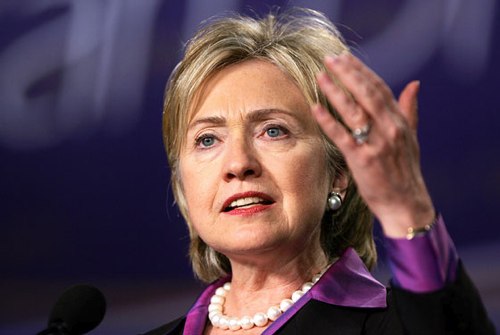
Secretary of State Hillary Clinton. Courtesy of thenews.com.
Egyptian protestors’ success in removing President Mubarak from power has spiked political unrest in other areas of the Middle East. The country of Libya has descended into violent commotion as Gaddafi fights back against protesters. The king of Bahrain is facing opposition and has sent in Saudi forces to take control of the protesters using threats and violence. Each country has a similar story with powerful consequences.
The political, social and economic turmoil of the Middle East has quickly become an issue the rest of world must face because it no longer impacts that region alone.
In reaction to this tumult, everyday citizens watch the rise in product prices. Gas price increases are one of the biggest issues that make American citizens look around and ask, “what is going on?” Some are oblivious to what happens in the world around them while others are in outrage as they finally see how differently these countries function.
“Probably the best thing Americans could do is work harder at learning as much as possible about Middle Eastern countries and governments,” Dr. Dave Rausch, WT Political Science professor, said.
In dealing with the Middle East, America plays a careful role by not making outright demands or declaring strong political decisions that largely impact society and the economy. The decision to interfere is a slow process.
“The problem is that we have supported those leaders either because their countries have natural resources we need or because they were a buffer against the Soviet Union in the past and fundamentalist Islam today,” Rausch said.
Obama is working to preserve what relationships he can, whether it is to sustain social responsibility, avoid more economic crisis or evade dangerous political problems.
“The Obama administration, like most Americans, does not know what to do,” Rausch said. “Everyone likes democracy, but sometimes elections in Middle Eastern countries go awry.”
The United Nations declared that they would not stand by idly and watch civilians die. As a result French, British and U.S. forces have become a part of the fight in Libya. U.S. ships fired missiles from the coast of Libya aiming to take out radar and communications locations. The British aided the Americans from a submarine. The French have fired from airplanes above the city. U.S. Secretary of State Hillary Clinton has stated the U.S. has become involved in Libya, but that this is an international effort.
Libya has responded to the attacks by saying they are barbaric. Libya claims that the attacks have not only destroyed places, other than the targeted areas, but lives have been put in danger and lost because of the missiles fired under the U.N.’s authorization.
As long as revolts and uprisings continue in the Middle East, America will be affected. Political tension is running high, and this has become a time filled with stressful situations. The political upheaval does not seem to be slowing down, and America continues to balance their actions to avoid severe consequences.
For many around the world it has become a question of what will happen next and what is the next step for the Middle Eastern countries.
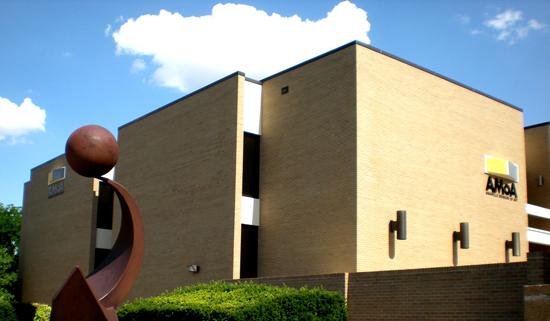
The Amarillo Museum of Art. Courtesy of amarilloart.org.
The Amarillo Museum of Art will be exhibiting art by WTAMU and Amarillo College students and professors from March 25 through April 10.
Students had the opportunity to have their pieces judged by professors if they wanted a chance to participate in the art show. Students will find out today whether or not their pieces were selected for exhibition in the art show.
The Amarillo Museum of Art has been hosting this show for 38 years. Alex Gregory, Amarillo Museum of Art curator of collections, said the founders of the Museum had a strong tie to the students and the Panhandle and believed that working with them was part of their mission.
“It was part of the idea of the founders to display art from students,” Gregory said.
The Museum will host a Gallery Talk on the opening day of the exhibit at 6:30 p.m. Students can receive a free membership to the museum by showing their WT or AC ID card.
The Museum is open Tuesday through Friday from 10 a.m. to 5 p.m. and Saturday and Sunday from 1 p.m. to 5 p.m.
The WTAMU Lady Buff softball team lost to the Incarnate Word Cardinals with a final score of 1-0 on March 12.
The Lady Buffs had faced off against the Cardinals March 11 for a double header coming away with one victory.
The Lady Cardinals defeated WT with a single RBI. Pitcher Shelby Cockrell picked up the loss in the circle, but only gave away one run on six hits. The Lady Buffs drop to 19-4 overall and 1-2 in LSC play.
The Lady Buffs host Adams State March 16 before traveling to play Abilene Christian University over the weekend.
WTAMU’s Lady Buff softball team improves to 19-3 on the season and 1-1 in Lone Star Conference play following a double header against the Incarnate Word Lady Cardinals on March 11.
The Lady Cardinals won the first game of the night with a no-hitter from pitcher Briana Sanchez. The game ended in five innings with a score of 11-0. WT pitcher Marci Womack gave up nine runs on 12 hits. Fellow pitcher Chantel Pearson gave up two runs on three hits. Pearson managed two strikeouts during the last 1.2 innings of game one.
WT rallied in the second game and game out with a 3-2 victory. The team scored twice during the fifth inning monopolizing on a baserunning mistake by Incarnate Word. WT appealed a two run homerun by Incarnate Word’s Monica Acuna and won the challenge, effectively putting an end to Incarnate Word’s attempt to rally in the second game.
Kaitlyn Witte was essential in this WT victory. Her batting drove in all three Lady Buff players. She hit 3-for-4 with an RBI single and a two run double.
WT pitcher Shelby Cockrell managed 11 strikeouts in game two. Her record improves to 11-1 in the circle.
WT faces the Lady Cardinals again March 12 at noon.
Ten members of WTAMU’s Forensics (speech) team have qualified for Nationals. The team will travel to Norman, IL. to compete at Illinois State University during the third week of April.
“So far the team has qualified 26 events in which they are able to compete,” Team Coach Connie McKee said. “We hope to have [qualified] 33 events by the end of the season.”
Shay Ward, a member of the team who has qualified for Nationals, said that preparation is the key to having success in speech competition.
“Preparation for our events is everlasting,” Ward said. “Generally it takes about a week to get our events up and memorized, but then we edit then, rewrite and fine tune based upon ballets we get at tournaments.”
The Forensics team has grown and boosts a few new members.
“Three of the members are first year competitors in the college circuit,” McKee said. “One of them has never competed in speech before this year.”
Ward said participation on the team helps prepare people for the future.
“As a communication event, this organization is creating the future public speakers who can create change in society,” Ward said.
McKee said that they have some high goals for this season.
“Our goal is to place first in sweepstakes,” McKee said. “This really is a possibility this year. We will be in the top three.”
Ward said one of the keys to the success of the team is the cohesiveness of the group.
“We are a family,” Ward said. “While competing in forensics its hard to maintain friendships elsewhere due to the time involved in the activity. We are each others backbone in our trek to Nationals as well as an entertaining social life.”
McKee agrees that the team is in fact a team and not a group of individuals who refuse to work together.
“They have worked very hard and they have worked as a team,” McKee said. “They help and encourage each other.”
The team still has over a months worth of competition to qualify for more events.
The Super Bowl is America at its finest – football fans slouched in front of a TV, gorging on junk food, screaming at inanimate objects and betting on the outcome of something they have no control over.
Perhaps this is a generalization. Perhaps millions of Americans use the Super Bowl as a chance to gather with friends and enjoy some common ground. Perhaps Super Bowl Sunday is a reprieve from the reality of budget deficits, wars in foreign countries and past-due bills lying on the desk in the bedroom. Perhaps Super Bowl Sunday is one day for Americans to indulge.
Perhaps…but I think not. From August to February, there is at least one game every week that symbolizes American indulgence. It also shows American’s inability to prioritize. Facebook screams in outrage when a player fumbles a pass, but merely groans (if it is mentioned at all) when a nation such as Egypt is in turmoil, or when major legislation is being proposed or when something of actual importance happens.
I realize that football and all professional sports stimulate the economy; therefore, I don’t think they should be banished entirely. I do, however, firmly believe that sports should be lowered from its pedestal in America. The only value I find in sports is when the U.S. participates in the Olympics because that is a tool for strengthening foreign relations.
Super Bowl Sunday is super boring: lots of loud louts screaming at a TV while non-sports fans wait for a possible witty commercial about beer. Super Bowl is some sort of falsified holiday smashed in between Valentine’s Day and Groundhog Day to keep commercialization flowing at its peak. Personally, I won’t be buying into it.
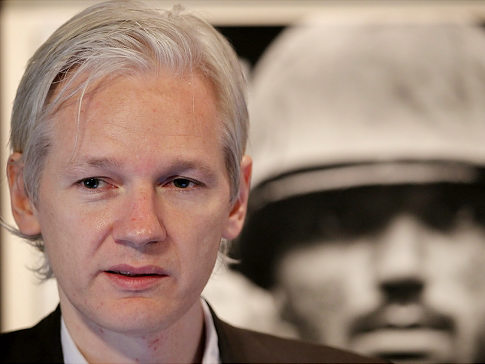
LONDON, ENGLAND - JULY 26: Julian Assange of the WikiLeaks website speaks to reporters in front of a Don McCullin Vietnam war photograph at The Front Line Club on July 26, 2010 in London, England. The WikiLeaks website has published 90,000 secret US Military records. The Guardian and The New York Times newspapers and the German Magazine Der Spiegel have also published details today. (Photo by Peter Macdiarmid/Getty Images)
The actions of Wikileaks, an organization that publishes secret documents, could adversely impact freedom of the press in the United States.
Dr. Dave Rausch, a political science professor at WTAMU, said Wikileaks should be considered a branch of the media.
“Wikileaks is a media outlet,” he said. “I am a bit concerned that the writers for Wikileaks aren’t trying to inform the public as much as they are trying to get lots of public attention. It might have been better to provide the information to newspapers that have a more established line of protection.”
Rausch noted that he does not support any restrictions against the press. He feels the actions of Wikileaks do not validate the government taking a hold of the media and filtering content.
“The challenge with Wikileaks is the website is causing Americans to consider some restrictions on the press,” he said. “Any opinions about restriction the press are not good.”
He said he thought a more time tested part of the media could have handled the dissemination of the information better than Wikileaks.
“A traditional newspaper could have published the basic outline of the documents without releasing specifics or damaging details,” he said. “Wikileaks just published the documents with little commentary.”
Matthew Schmitto, a member of the group Young Americans for Liberty, said he feels Wikileaks has not violated the Constitution because its founder, Julian Assange, is not an American.
“I don’t think Wikileaks is bound by our Constitution,” he said. “[They] owe no loyalty or anything else to the United States. If anything we should be thanking them for showing us [what] our government is using our tax money towards.”
Rausch said using the internet as the main medium to spread Wikileaks information causes a new problem.
“The Internet makes it easy to distribute information to a worldwide audience,” he said.
He noted that the Internet makes jurisdiction problematic. If none of the leaked information was published on U.S. soil, it would be difficult to validate charging and trying Wikileaks members in America. Additionally he said that it would be difficult for the courts to decide whether the person that gave the information to Wikileaks or Wikileaks itself was responsible for committing a crime.
Schmitto said he foresees regulations against the Internet taking place. He expects fewer attempts to control freedom of the press.
“I definitely think that the government will continue to gather new regulations on the Internet in the future in an attempt to prevent something of this nature from happening again,” he said.
Schmitto said that U.S. government is already planning restrictions to pass into law.
“I think Wikileaks is going to dramatically affect the freedom of the Internet,” he said. “Senators and Congressmen have already begun writing up new legislation that will provide immense amounts of regulations in effect jeopardizing the freedom of the Internet that we are used to.”
Both Schmitto and Rausch agree that freedom to publish information will be adversely impacted because of the panic WIkileaks has caused. However, it is unclear whether the government will try to rein in established forms of media or try to strictly regulate the Internet.
Recently, a Norwegian official nominated Wikileaks for the 2011 Nobel Peace Prize because it is a step towards more transparency and a heightened level of freedom of speech. Founder Julian Assange said, in a 60 Minutes interview, that he feels Wikileaks is based off of the same inquisitive nature that propelled the Founding Fathers.
This month the editors of the New York Times and the Guardian both promised to defend Assange if the U.S. ever attempts to prosecute him for the information released through Wikileaks. Since the initial outrage caused by the leak of previously unknown government secrets, many supporters have come out of the woodworks to back the efforts of Assange towards transparency.
It’s unlikely that Wikileaks will go away. Wikileaks reported that the organization has released less than one percent of the amount of data it has gathered.
WT President Dr. J. Patrick O'Brien at the Town Hall Budget Meeting. Photo by Katelyn Garrity.
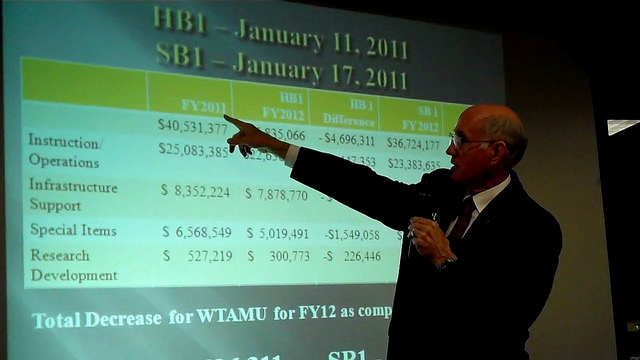
WTAMU faces a budget shortfall as the state of Texas demands cuts from higher education.
President O’Brien said WT has committed to give 7.5 percent of the budget for fiscal year 2011 back to the state to try and offset the deficit facing Texas.
“The state essentially is shifting the cost [of college] to the students and parents and away from the tax payers,” O’Brien said.
O’Brien said that students and universities should expect these cuts to continue.
“For the foreseeable future higher education is not going to get anymore than what it got in this current biennium,” O’Brien said.
The University is looking at a variety of ways to cut costs to make up for this budget shortfall. For example, these cuts have led to a freeze on all unnecessary hiring of new professors and other faculty. The University has even gone so far as to change the type of disinfectant it uses in hopes of cutting $40,000 from the budget. Tuition however is not on the list of things looking to be increased.
“At this point, we are not looking at an increase in designated tuition,” O’Brien said.
The Texas A&M system has put a two year moratorium on raising tuition. However, O´Brien said that when this moratorium expires it may be necessary to raise tuition.
“The University is looking at all sorts of different ways to save,” O’Brien said.
This will include a variety of fee increases such as the Student Service Fee, the Medical Service Fee and the Technology Fee. Other fee increases are also being considered to help offset the budget shortfall. The overall estimate is that there will be a 3.6 percent fee increase.
O’Brien emphasized that despite the fact that cuts have to be made, WT still ranks as one of the most cost effective institutions in the state.
“In terms of institutions in the state, we’re below the median in what we charge for tuition,” O’Brien said. “We’re 23 of 34.”
Dan Garcia, vice president for enrollment management, noted that WT is still the best alternative for an education.
“Even though we cost more than a community college, we cost less than other four year universities,” Garcia said. “We give more financial aid than other two year schools.”
Student jobs and class sizes were both issues brought up during the Town Hall Budget Meeting on Jan. 26. O’Brien admitted that there will likely be an increase in class sizes. Student jobs, however, have a brighter future.
“I don’t see that this will impact student jobs on campus,” O’Brien said.
The problem WT will face with an increase in class sizes is the limited number of rooms on campus that can hold a large number of students. O’Brien said the Institution is currently considering revamping areas of the Classroom Center to make larger classrooms.
Scholarships and financial aid are safe from all the budget cuts.
“We’re not reducing scholarship funding,” O’Brien said. “In fact each year we increase scholarship funding.”
Currently, 20 percent of designated tuition goes into scholarship funds. The University is also campaigning to get more money from private donors to help increase the funds available for financial aid and scholarships.
Garcia and O’Brien agree that the best thing that could happen for the University is an increase in enrollment.
“With every new student that enrolls we receive additional resources,” Garcia said. “If the state continues to take from higher education we’ll at least be able to maintain the same level prior to the cut [if enrollment increases].”
According to O’Brien a 1 percent increase in enrollment is the equivalent of $190,000 in tuition revenue.
Garcia said his main concern is that these cuts will make more students feel unable to achieve higher education.
“I’m concerned because over time the costs have gone up measurably,” Garcia said. “It can make some families believe it is out of reach. But financial aid has gone up every year.”
Garcia emphasized that programs like Buff Promise are available to help students. He also said that all students should be sure to fill out the FASFA. According to a report released by finaid.org, many students think that they don’t qualify for aid when in fact they do qualify to have a portion of their costs covered.